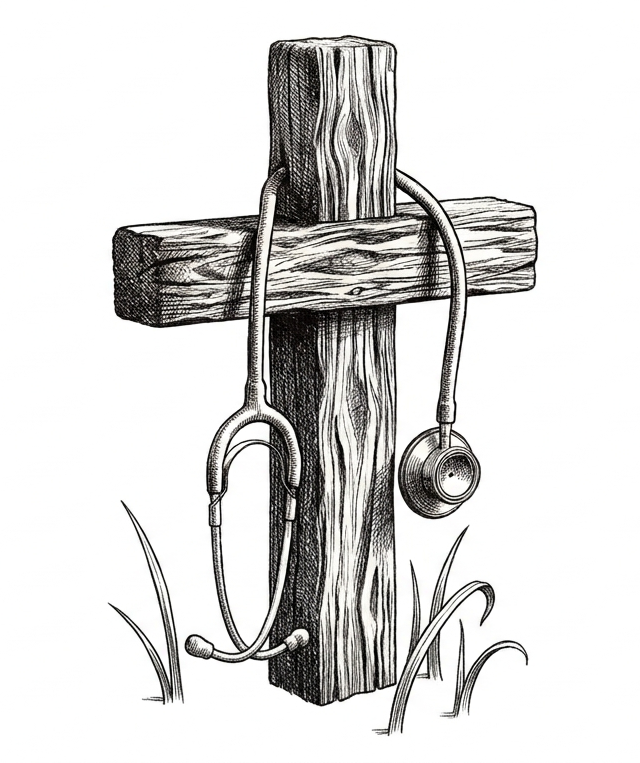
Christian Faith on Human Illness and Suffering
Doctors deal with human illness and suffering. From the first day of medical school, it is what they are trained to do – to be healers of the human body. Yet, pastors and ministers of God’s word also deal with human illness but from a different perspective. For centuries, these two different perspectives have all too often come to loggerheads, at least in the view of some people.
The Gospel
It is impossible to discuss Christian faith as it relates to human illness and suffering—or to discern God’s purposes in the midst of suffering—without first understanding the gospel. So then, what is the gospel? At its heart, the gospel is God’s message of good news to humanity. It proclaims that salvation is available to all people through Jesus Christ, who not only proclaimed the good news but is Himself its very embodiment. By Jesus’s life, death, and resurrection, God accomplished the redemption of all who place their faith in Him. This glorious truth is expressed in numerous passages throughout the Bible, but it is perhaps best summarized in the most commonly quoted verse found in the Book of John:
“For God so loved the world that he gave his only son, that whoever believes in him shall not perish but have eternal life. (John 3:16, ESV).
For centuries, this promise of eternal hope served as the ultimate anchor for human understanding – including an understanding of human illness and suffering. In our modern era, however, the source of answers that humanity now turns to has shifted somewhat towards a worldly view.
Today’s Worldly View
A worldly view is grounded in the material world. Existence is governed by physical laws, evolution, and human agency. God is either absent or unnecessary. Fulfillment comes from personal achievement, self-expression, material security, and making a temporal impact. Truth and ethics are often relative and shaped by societal consensus, personal feelings, or practical outcome.
Our High-tech World
Today we live in a high-tech world with cell phones, electric cars, and instant global communication. Science has come so far that people expect medical cures for just about any human illness. The entire human genome has been mapped out, and vaccines are engineered from human building blocks like RNA. All of these are wonderful things, but unfortunately, they have caused many to rely solely on human wisdom (taking a worldly view) for everything. As such, science and Christian faith have come all too often to loggerheads.
The Hard Stop of Worldly Wisdom
Yet, despite all of these extraordinary advances, human wisdom and scientific ingenuity ultimately reach a hard boundary when confronted with the deepest realities of illness and suffering. Science can explain the physical mechanisms of a disease, map the mutations of a tumor, or prescribe medications to dull physical pain, but it cannot heal a broken spirit or answer the fundamental question: “Why?” When an aggressive diagnosis proves untreatable, or when a sudden loss shatters a family, high-tech tools offer no ultimate comfort. A smartphone cannot offer meaning in grief, and an algorithm cannot provide hope in the face of mortality. Human knowledge can manage our physical symptoms, but it is fundamentally incapable of granting soul-deep peace when our control slips away.
Peace of the Lord
This is precisely where the gospel fulfills humanity’s most dire need—offering a peace that human intellect can never produce and a hope that never fails. Unlike human wisdom, which relies on our ability to fix problems, the gospel reveals a God who stepped directly into human suffering through Jesus Christ. Christ did not remain distant from our pain; He experienced betrayal, physical agony, and death on the cross, demonstrating that our suffering is never ignored or meaningless. By conquering death through His resurrection, Jesus transforms our earthly hardships from ultimate tragedies into temporary trials, promising eternal restoration to all who believe. While medicine can only delay our physical end, the gospel secures our eternal future, anchoring the human heart in an unchanging love that holds firm no matter how fragile our physical bodies become.
A Physician Witnesses Peace of the Lord
This profound contrast between temporary medical remedies and eternal spiritual assurance is vividly illustrated in Dr. Francis Collins’s book, The Language of God. Early in his medical career, while still an atheist, Collins encountered an elderly woman suffering from severe, untreatable angina. Despite her intense physical pain and the certainty of her approaching death, she possessed an undeniable, deep-seated peace rooted in her faith in Jesus Christ. One day, after sharing her quiet trust in the Lord, she turned to Collins and asked a simple, direct question: “Doctor, what do you believe?” Realizing he had no answer, Collins was shaken by the realization that while his medical training could do little to alleviate her terminal condition, her faith in the gospel provided her with a peace that surpassed all human understanding. That moment exposed the limits of purely scientific answers and set one of the world’s leading geneticists on a journey toward discovering the reality of God’s peace for himself.
But Why do We Need to Suffer?
Let’s be clear. God does not cause evil, and He does not cause our suffering. But He does allow it to happen, and when it happens, whether it is a natural disaster, human disease, or human-derived acts of cruelty, it most often brings about human suffering. God, however, uses these painful times to achieve his own purposes. Said differently, He takes something that is bad and makes something good out of it. As the Apostle Paul states:
And we know that for those who love God all things work together for good, for those who are called according to his purpose. (Romans 8:28, ESV).
A Primary Purpose – Trust
A primary purpose in God allowing human suffering is to teach us to trust in Him and not in ourselves – to trust Him over our worldly wisdom. It is like a parent’s tough love. Parents frequently have the urge to help their children who might be struggling. Yet, they know that there are times in which not helping them, but rather using tough love, will be better for the child in the long run. A loving parent might take his or her small child to the doctor’s office for a vaccination. The child suffers fear and the pain of the injection. He does not understand why his dad would allow this to happen to him. The father loves the child and has the power and authority to stop the pain by cancelling the vaccination, but he allows it to happen because he knows it is good for the child. The child does not understand this in the present, but he will in later years as an adult. God allows suffering in a similar fashion. Essentially, He may allow something painful to happen in order to achieve a greater good for us. He does this because He loves us more than we can even fathom. And, just like the child in this analogy, we may not understand at the time of the suffering, but our perseverance in faith through it will make our faith stronger and our trust in Him greater. This helps shape us to be more like Jesus Christ, and it brings us evermore closer to our Father in Heaven. As Job stated,
Behold, blessed is the one whom God reproves; therefore despise not the discipline of the Almighty. (Job 5:17, ESV).
Faith and Trust
In conclusion, belief and trust in God go hand in hand. One cannot have one without the other. It is one thing to intellectually believe in God’s word. It is quite another thing to live out that belief. True faith must involve one hundred percent trust in God. Not ninety percent, not even ninety-nine percent. It must be one hundred percent. Human illness and suffering is never easy. But true faith – belief and trust – will bring peace, a peace that surpasses anything that the world can offer.